
CONTEXTE & EN JEUX
A Traditionally Monopolistic Market Opening to Competition
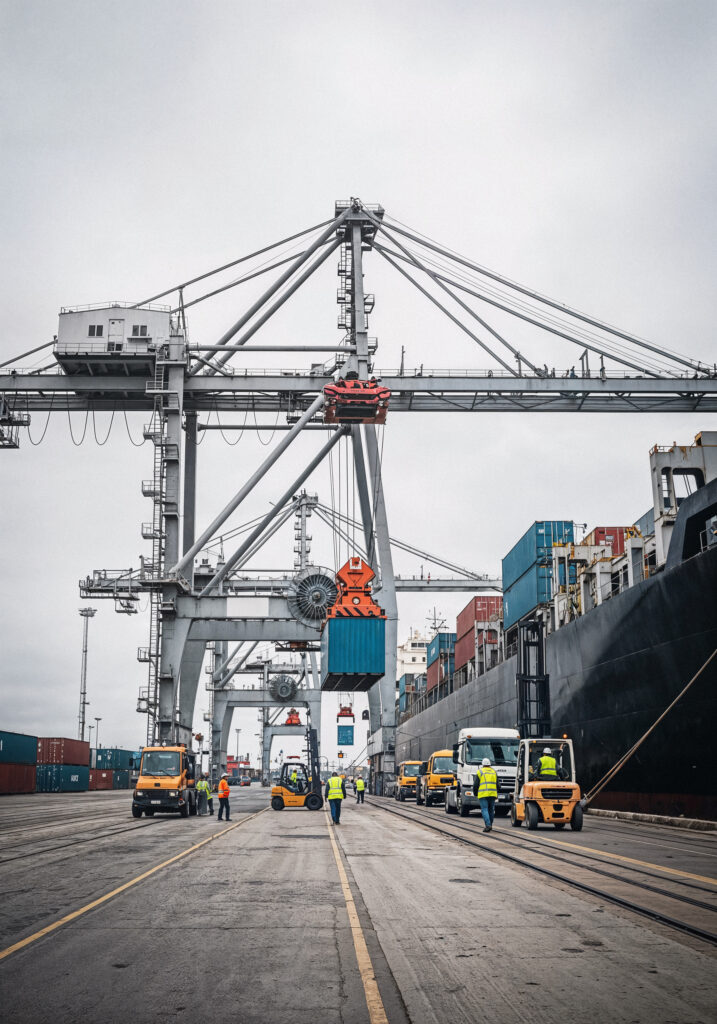
A leading port operator, recognized as the national leader in the management of multi-purpose terminals across several ports, faced a highly sensitive situation with a significant risk of revenue loss. The port authority had recently completed the construction of a new multi-purpose terminal and was considering granting its operation to one or more competitors within a port already characterized by substantial overcapacity.
The key challenge was clear: how could our client redefine the scope of its concession to integrate these new capacities, avoid a destructive price war, and preserve its financial balance while maintaining operational efficiency within the port?
collaborateurs répartis entre les trois business units
Ingénierie, Réseaux et Technologie, aux métiers et cadres juridiques distincts
Horizon du plan stratégique à co-construire (2022–2026)
Port utilization rate before the addition of new capacity
The operator holds concession rights through two separate group entities, each operating under distinct contracts, royalty structures, and concession durations.
Currently in operation, plus the new terminal to be integrated into the strategic framework.
NOTRE DÉMARCHE
A Two-Phase Mission: From Diagnosis to Negotiation Strategy
Massir Invest structured the engagement through a progressive and results-oriented approach. The first phase focused on gaining a comprehensive understanding of the port’s operational and economic realities to identify available strategic levers. The second phase focused on building the negotiation framework and supporting decision-making tools.
| PHASE 1 | PHASE 2 |
|---|---|
| Situation Assessment & Operational Scenarios Audit of traffic flows by terminal, seasonality patterns, the legal framework of existing concessions, and demand forecasts. | Financial Modeling & Negotiation Framework Modeling the EBITDA and EBIT impact of each scenario over a five-year period. |
LE DIAGNOSTIC
An Overcapacity Port Environment with Diverse Traffic Flows and Strong Seasonality
The analysis of traffic flows over a four-year period revealed contrasting trends: strong growth in bulk cargo volumes, alongside stagnation or a slight decline in other traffic segments, particularly container traffic. Monthly traffic variation exceeded 25% for certain cargo categories, highlighting the need for a strategic approach to managing peak demand periods.
In addition, the port handled specialized traffic such as cruise and Ro-Ro operations without dedicated infrastructure, resulting in recurring operational disruptions on multi-purpose terminals — an additional constraint that had to be considered in any future reconfiguration scenario.
Four Scenarios Evaluated, One Clear Recommendation
Massir Invest structured the scenarios around two key decision criteria: traffic allocation across terminals (multi-purpose operations vs. specialization) and the strategic positioning of the subsidiary (strategic asset vs. survival mode). A fourth scenario — involving a competing operator managing the new terminal — was modeled as a baseline case to strengthen the argument presented to the port authority.
The objective was to demonstrate that granting the new terminal to the incumbent operator under the recommended scenario would provide the best operating conditions for the port while also generating higher concession revenues for the port authority, even when compared to awarding the terminal to a new competing operator.
| Scenario | Strategy | New Terminal | Group Profitability | Recommended |
|---|---|---|---|---|
| Spe1 | Specialization — Bulk Cargo Subsidiary | Subsidiary | High | No |
| Poly1 | Multi-Purpose Operations — Strategic Subsidiary | Subsidiary | Moderate | No |
| Poly2 ★ | Multi-Purpose Operations — Maintained Subsidiary | Main Operator | Maximum | Yes |
| Baseline | New Competing Operator | Third Party | Negative Impact | No |
LES SCÉNARIOS CONÇUS PAR MASSIR INVEST
The objective was to demonstrate that granting the new terminal to the incumbent operator under the recommended scenario would deliver the best operational performance for the port while maximizing concession revenues for the port authority, even when compared to the introduction of a new competing operator.
- Strategic Refocusing
Reduce the number of diversification areas to concentrate resources on market segments where each business unit holds a distinctive competitive advantage.
Discontinue activities that do not address recurring needs within the group’s ecosystem. - Business Models for the Energy Transition
Identify and compare different positioning models (carrier, buyer-distributor, producer-distributor)
to secure future revenue streams for the network business unit in the context of electricity market liberalization. - Cross-Business Synergies
Strengthen complementarities among the three entities: engineering supports renewable energy projects,
technology enhances facility management operations, and all three business units collaborate on export business development. - Domestic and International Growth
Establish revenue allocation targets between captive activities, domestic markets outside the group, and export markets,
supported by clear milestones and dedicated resources. - Institutional Resilience
Integrate institutional reforms into strategic scenario planning
and develop a differentiated positioning strategy that ensures the long-term sustainability of each activity in the eyes of regulators.
Les livrables remis au client comprenaient un rapport de synthèse complet, une matrice d’activités restructurée par business unit, des projections financières actualisées sur la période 2022–2026 et un argumentaire structuré destiné à la présentation aux instances de gouvernance.
La valeur ajoutée de Massir Invest sur ce type de mission
What Massir Invest Delivered
|
Décrypter la complexité